While the rest of the world chases visitor numbers, the last Himalayan kingdom decided crowds were the problem. It measures success in happiness, runs a carbon-negative economy, and makes you pay for the privilege of not ruining it.
Most countries want more tourists. Bhutan spent fifty years making sure it gets fewer.
The tiny Himalayan kingdom, wedged between India and China, charges most foreign visitors a Sustainable Development Fee of US$100 per night — on top of flights, hotels, food, and everything else. That’s not a visa cost or a tax dodge. It’s a deliberate wall, built to keep the crowds thin and the country intact.
It sounds arrogant until you see what it buys.
A country that measures happiness instead of GDP
In the 1970s, Bhutan’s fourth king floated an idea that economists found either charming or absurd: a nation should measure its success not by Gross Domestic Product but by Gross National Happiness. Wellbeing, culture, environment, and good governance would count as much as money.
It became national policy — and, crucially, it wasn’t just a slogan. GNH shaped how Bhutan built roads, ran schools, and, yes, handled tourism. If unchecked visitor numbers would erode the culture and trash the landscape, then unchecked visitor numbers were bad for the national bottom line, by definition.
So they capped the flow. High value, low volume: fewer travellers, each contributing more, treading more lightly.
The only carbon-negative country on Earth
Here’s the number that should stop you: Bhutan doesn’t just offset its emissions — it absorbs more carbon than it produces. Its vast, protected forests make the entire country a net carbon sink.
That’s not an accident either. Bhutan’s constitution mandates that at least 60% of the country remain under forest cover, forever. Not a target. A legal floor. Try to imagine any other nation writing that into its founding document.
The tourism fee funds exactly this kind of thing — free healthcare, free education, conservation, and infrastructure — which is why the government frames the $100 as an investment in the place, not a toll on the visitor.
What you actually get for the money
Bhutan is not a bargain, and it’s not trying to be. What it offers instead is scarcity in its rarest form: a Himalayan Buddhist kingdom that hasn’t been sanded smooth by mass tourism.
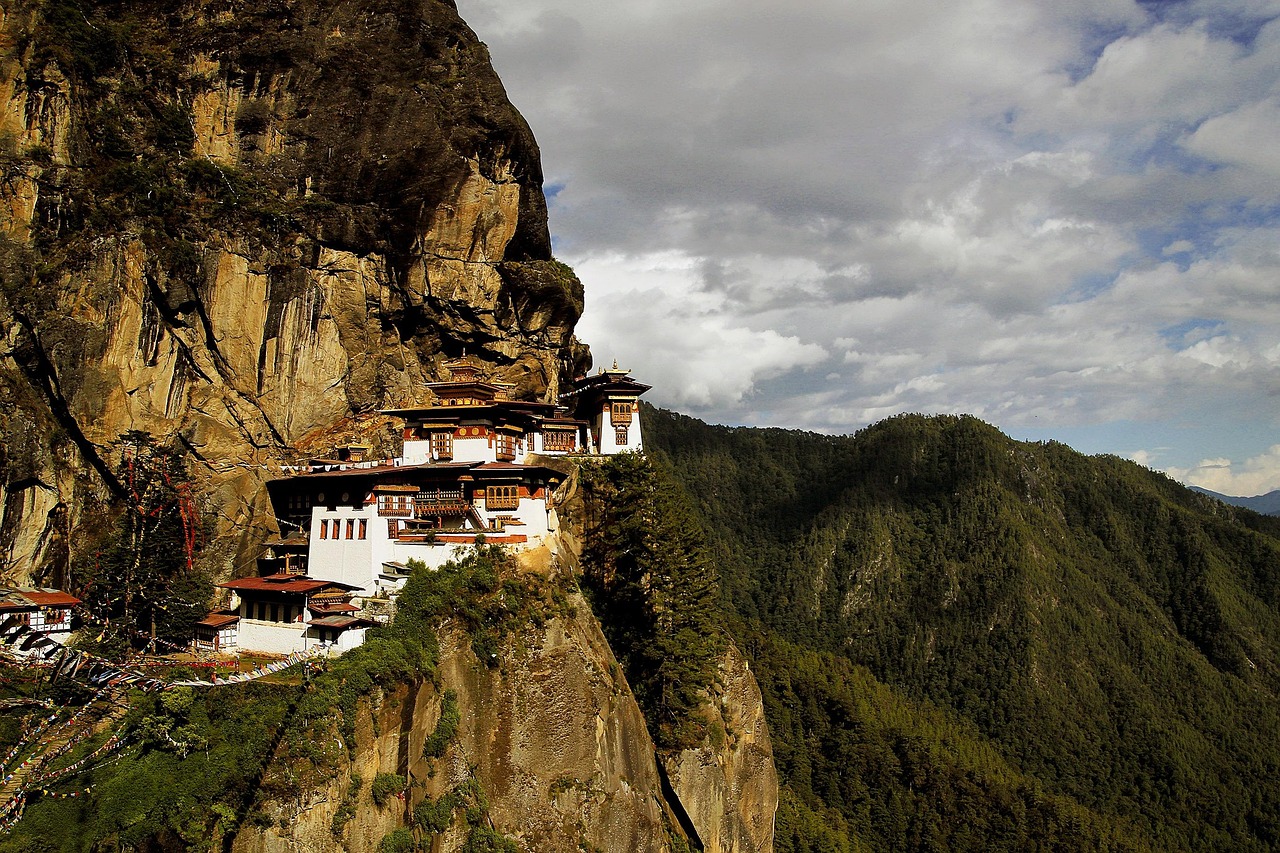
Monasteries clinging to cliff faces. Valleys without a single billboard. Festivals that exist for the people who live there, not for the cameras. The famous Tiger’s Nest monastery, hanging off a sheer rock wall 900 metres above the valley floor, still feels like something you earned rather than queued for.
You leave with fewer photos than you’d get in Bali and a stronger sense that you saw something real.
Why this might be the future of travel
For decades, “successful destination” meant “record arrivals.” Then Venice started drowning in day-trippers, Barcelona’s residents began protesting, and Everest grew a traffic jam. The infinite-growth model of tourism turned out to have the same flaw as every other infinite-growth model: the thing everyone’s coming to see gets destroyed by everyone coming to see it.
Bhutan looked at that math early and refused to play. Its bet is that a place is worth more kept whole than sold cheap — and that the travellers worth having will pay for the difference.
It’s easy to call it elitist, and there’s a fair debate there. But it’s harder to argue with the results: a country that stayed itself while everywhere else was busy becoming a photo of itself.
The next time a destination brags about breaking its visitor record, remember there’s a kingdom in the mountains that would consider that a failure.
Sources & further reading
Researched and written with the help of AI tools and edited for accuracy. Provided for general information and discussion only — not professional advice. See our editorial standards and disclaimer. Spotted an error? Tell us.
Enjoyed this? Get the next one.
One good read at a time, straight to your inbox. No spam, unsubscribe anytime.