Ashoka commanded the largest empire the Indian subcontinent had ever seen. After one war left 100,000 dead by his own count, he did the rarest thing a man with absolute power can do — he changed course, and carved the reasons into rock.
Around 261 BCE, on the coastal plain of Kalinga — modern Odisha, on India’s eastern seaboard — an army finished its work. When the tally was taken, the victorious emperor recorded the numbers himself. One hundred thousand killed. A hundred and fifty thousand marched away as captives. And “many times that number” dead of the wounds, hunger, and disease that trail behind a war.
We know these figures for an unusual reason: he published them. Not a defeated chronicler, not a rival — the winner. He had them cut into rock, in his own voice, next to a sentence almost no conqueror in history has ever left behind: that the slaughter filled him with deep remorse.
The emperor was Ashoka, third ruler of the Mauryan dynasty. At that moment he commanded the largest empire the Indian subcontinent had ever seen. What he did next is the reason we still say his name two thousand years later.
The colossus he was handed
Ashoka didn’t build his empire. He inherited a machine already at full power.
His grandfather Chandragupta Maurya had founded the dynasty around 321 BCE, welding most of northern India into a single state. His father, Bindusara, pushed it further. By the time Ashoka took the throne — he reigned roughly 268 to 232 BCE, though ancient Indian chronology is loose enough that you’ll see the dates nudged a few years either way — the Mauryan Empire stretched from Afghanistan to nearly the southern tip of the peninsula.
It was, by most reckonings, the first time the subcontinent had been governed as one thing. Ashoka ran it from Pataliputra (today’s Patna), through a vast bureaucracy, a standing army, and a network of roads and spies. He was, in the plainest sense, one of the most powerful individuals alive on the planet.
Early accounts don’t paint him as a gentle man. Later Buddhist legend even nicknames the young king Chandashoka — “Ashoka the Fierce.” Whatever the truth of the stories, the empire he ruled was built and held by force. Which is what makes the turn so strange.
One coastal kingdom he didn’t yet own
Kalinga was the gap in the map. A prosperous, independent kingdom on the east coast, with its own trade and its own fleet, sitting stubbornly outside Mauryan control while everything around it had been absorbed.
About eight years into his reign, Ashoka went to take it. He won. Kalinga was a serious military power, and breaking it meant a war ferocious enough that the emperor never forgot the arithmetic of it.
Here is the thing to sit with. Rulers had won bloody wars before, and would for millennia after. What virtually none of them did was memorialize the cost as a moral failure of their own. Ashoka did. In the inscription historians call Major Rock Edict XIII, he set down the numbers and then wrote that “Beloved of the Gods” — his own regnal title — “feels deep remorse for having conquered the Kalingas,” because when an unconquered country is taken, “slaughter, death, and deportation” fall on people who did nothing to deserve it.
A conqueror, at the peak of a successful campaign, publishing his own confession. It has almost no parallel in the ancient world.
The pivot most men with power never make
Out of that remorse came a decision that reads, even now, as close to unbelievable: an emperor at the height of his strength chose to stop conquering.
Ashoka renounced war as an instrument of state. In its place he announced what the edicts call conquest by dhamma — victory through moral principle rather than the sword. He didn’t disband the army or pretend the empire could run on goodwill alone. But he declared, in stone, that he wanted his sons and grandsons to give up the idea of new conquests, and that the only conquest worth having was the ethical kind.
He had turned, in the same years, toward Buddhism, then a few centuries old. The neat story — a battlefield epiphany, an overnight conversion — is partly the work of later Buddhist tradition, and worth holding loosely. What the emperor’s own inscriptions show is subtler and, honestly, more convincing: a man deepening into a new philosophy over years, growing more committed to it the longer he ruled.
Absolute power almost never reverses itself. Ashoka spent the back half of his reign trying to.
What “dhamma” actually meant
It would be easy to picture this as a king simply going pious. It was more interesting than that.
Ashoka’s dhamma (the Pali form of dharma) wasn’t a demand that everyone become Buddhist. It was closer to a public code of decency he tried to broadcast across a wildly diverse empire: non-violence where possible, honesty, generosity to the poor, respect for elders, kindness to servants and even to animals — and, strikingly, tolerance between religious sects. One edict urges people to honor other faiths, on the grounds that running down someone else’s religion only debases your own.
He didn’t just preach it. He appointed a class of officials — dhamma-mahamatras, roughly “officers of morality” — to spread the ethic and check on the welfare of his subjects. He funded medical care, dug wells, planted shade trees along the roads, and set up rest houses. He restrained the royal kitchen’s appetite for slaughtered animals.
This is a working emperor trying to govern by moral example, and building institutions to do it. Not a saint who retreated from power — a ruler who tried to bend power toward conscience while keeping it.
The first mass-media campaign in history
To reach an empire that couldn’t read a single shared language, Ashoka did something that turned out to be his most durable act: he wrote on the landscape itself.
His edicts — dozens of them — were carved onto boulders, cave walls, and tall polished sandstone pillars, scattered from the northwest frontier to the deep south. They are, today, the primary evidence for almost everything we know about him. Not a court poet’s flattery. The king’s own words, addressed to ordinary people, in the everyday Prakrit language and the Brahmi script.
And in the northwest, where his subjects were descendants of Greek and Persian settlers, he had the message rendered in Greek and Aramaic so they too could read it. A bilingual edict still survives at Kandahar, in Afghanistan. Think about the ambition: a single ruler broadcasting a moral program in three languages across a subcontinent, seventeen centuries before the printing press.
He didn’t keep Buddhism to himself
Ashoka became Buddhism’s great patron, and that patronage is a large part of why the religion grew from a regional movement into a world faith.
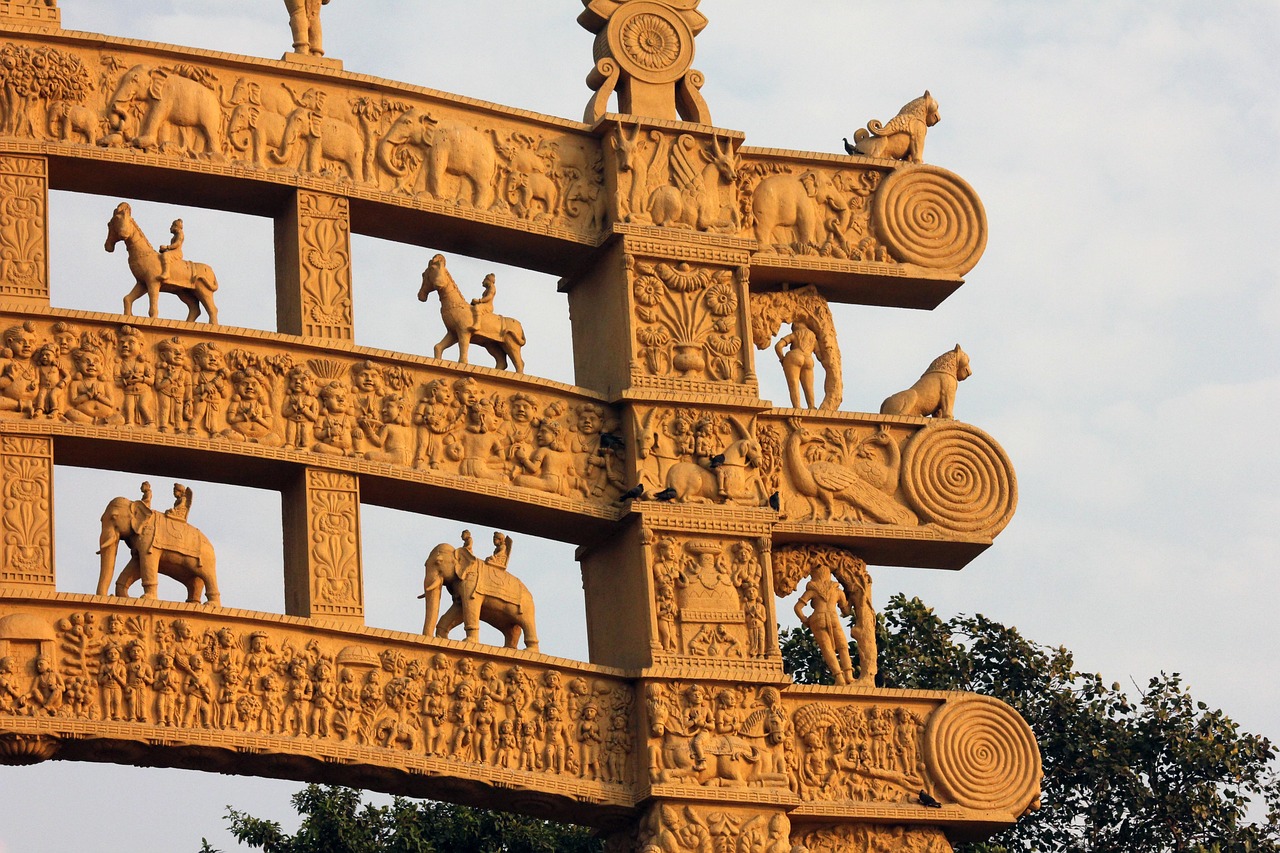
He is credited with convening a great Buddhist council at Pataliputra to settle disputes and purify the teaching. He built monasteries and stupas — domed reliquary monuments — to house Buddhist relics; tradition puts the number at a symbolic 84,000, which is legend more than ledger, but the building program was real. The Great Stupa at Sanchi, in central India, was originally raised under Ashoka in the 3rd century BCE and still stands — now a UNESCO World Heritage Site.
Most consequentially, he sent missions abroad. According to Sri Lankan tradition, Ashoka dispatched his own son, the monk Mahinda, to the island, where he converted its king and planted a form of Buddhism that survives there to this day. Emissaries carried the teaching outward in other directions too. An emperor’s personal crisis of conscience became, over centuries, a religion followed by hundreds of millions.
The king who had to be rediscovered
And then, for the better part of two thousand years, he was essentially forgotten.
The empire fragmented within about fifty years of his death. His edicts still stood in the open air, but the script had died, and no one could read them. For centuries, people walked past pillars covered in a message from a king who called himself only “Beloved of the Gods, Piyadasi” — a title, not a name — with no idea who that was.
The lock cracked in 1837, when a British East India Company official and scholar named James Prinsep deciphered the ancient Brahmi script. Out came a mysterious, benevolent monarch no history had preserved. It took further detective work — Sri Lankan Buddhist chronicles that named Ashoka, and a later inscription found at Maski in 1915 that finally spelled out “Devanampiya Asoka” in one breath — to prove that Piyadasi and Ashoka were the same man.
One of the most significant rulers in human history had to be excavated from his own stones like a lost city.
Why his face is on your rupee
When India became independent in the 20th century and went looking for symbols, it reached past the Mughals, past the British, past the Guptas — all the way back to Ashoka.
The Lion Capital that once crowned his pillar at Sarnath — four Asiatic lions standing back to back, carved in the 3rd century BCE — became the State Emblem of India, adopted on 26 January 1950. And the wheel from that same monument, the wheel of dhamma, became the Ashoka Chakra: the 24-spoked navy-blue wheel at the center of the national flag, adopted in July 1947.
So a 2,200-year-old Buddhist symbol, chosen by an emperor as the emblem of a moral idea, now sits on every Indian passport, every rupee note, every government letterhead. A war-sickened king’s chosen icon became a nation’s.
The rarest thing power can do
Strip away the legend and the arithmetic still stops you cold. A man who held near-total power over a third of the subcontinent won the biggest war of his life — and treated the victory as a wound. Then he spent the rest of his reign trying to rule by conscience, and left the evidence carved where anyone could read it.
Historians rightly caution against sanding him into a flawless saint; the sources are thin, the legends are thick, and dhamma was still, in the end, a policy issued by an empire. But the core is not myth. It’s cut in rock, in his own words.
The writer H.G. Wells, cataloguing the thousands of “majesties and graciousnesses and serenities” who clutter the columns of history, put it this way: among them all, “the name of Aśoka shines, and shines almost alone, a star.”
That’s the part worth keeping. Power almost never turns around. Once, in the third century BCE, it did — and it thought the change was important enough to write down forever.
Sources & further reading
Researched and written with the help of AI tools and edited for accuracy. Provided for general information and discussion only — not professional advice. See our editorial standards and disclaimer. Spotted an error? Tell us.
Enjoyed this? Get the next one.
One good read at a time, straight to your inbox. No spam, unsubscribe anytime.