Photo: thakurankush1989 / Pixabay
Every time you write a number, you're using an Indian invention — a positional decimal system, and a symbol for nothing, that together rewired human thought. So why does almost nobody know where it came from, and why do we call the digits by the wrong name?
Write down the number 2,026. Look at that first digit. On its own, “2” means two. Sitting where it sits, it means two thousand. The digit hasn’t changed — its position gives it value. And holding those positions apart, keeping the thousands from collapsing into the tens, is a small, world-changing character: 0.
We use it so automatically that it feels like it was always there, like counting itself. It wasn’t. The system you were taught in first grade — ten digits, each worth ten times more one place to the left, with a symbol for nothing to anchor it all — was one of the most consequential inventions in human history. And it was worked out, over centuries, in India.
Here’s the strange part: the world took it, renamed it, and mostly forgot to say thank you.
Why “nothing” was the hard part
Plenty of ancient peoples could count. The Romans had numerals; the Babylonians had a sophisticated system; the Greeks did geometry that still humbles us. What almost none of them had was a clean way to write nothing as a number — and without that, arithmetic is a nightmare.
Try multiplying MMXXVI by XLVII in Roman numerals. There’s no column to carry into, no placeholder to keep the empty slots empty. That’s not a small inconvenience. It’s a ceiling on what a civilization can calculate.
The Indian breakthrough was to treat emptiness itself as a quantity you could write down and compute with. The word was shunya — “void,” a concept already deep in Indian philosophy. The leap was to drag that void out of metaphysics and into arithmetic, and give it a shape.
The men who made nothing count
By around 499 CE, the astronomer Aryabhata was using a place-value decimal system to run astronomical calculations of startling accuracy — positional notation, where where-you-write-it is the meaning.
But the decisive moment came in 628 CE, in a text called the Brahmasphutasiddhanta, written by the mathematician Brahmagupta. He did something no surviving earlier text had done: he treated zero as a number in its own right, and wrote down the rules for it. What happens when you add zero to a quantity. When you subtract a number from itself. How zero behaves in multiplication. He also formalised negative numbers — debts, on the far side of nothing.
He didn’t get everything right (his attempts to divide by zero were incomplete, a puzzle that would take a thousand more years to fully resolve). But he had turned “nothing” into a working tool. Arithmetic was never the same.
The oldest zeros we can still touch
Where’s the physical proof? Two artefacts anchor the story.
One is the Bakhshali manuscript, birch-bark folios of mathematics that use a dot as a placeholder for zero — the shunya-bindu, the “dot of the empty place.” In 2017, Oxford radiocarbon-dated parts of it to as early as the 3rd or 4th century, which would make it the oldest recorded zero anywhere. That early date is genuinely contested — several historians of Indian mathematics argue the manuscript was composed as a single, later work — so treat it as a live debate, not a settled record.
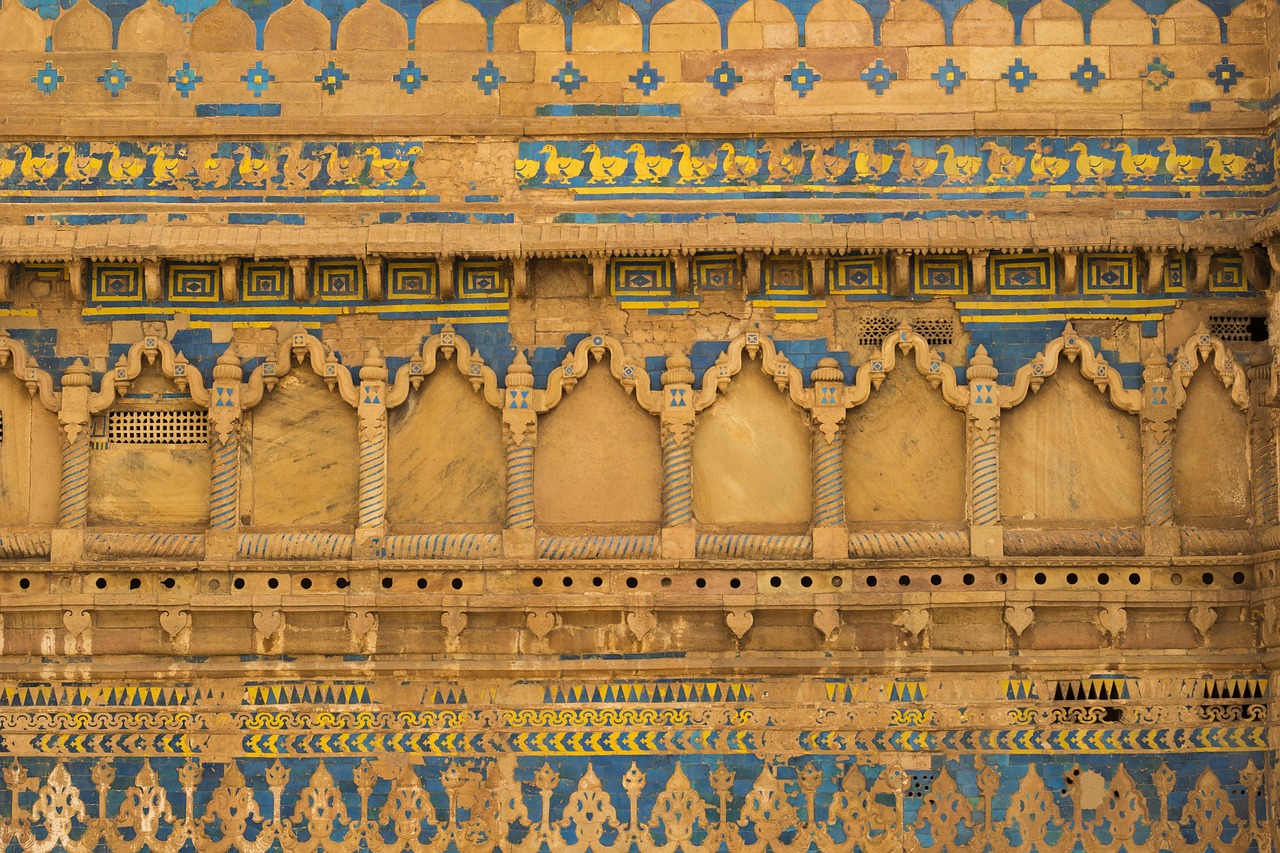
The other is beautifully solid: carved into the wall of the Chaturbhuj Temple in Gwalior, dated to 876 CE, sits the number 270 — with a small circle for the zero, unmistakably the ancestor of the one on your keyboard. It is among the oldest undisputed, dated zeros in the modern form, and you can go and put your hand on it.
How India’s numbers got someone else’s name
So how did the world end up calling them Arabic numerals?
Because of the route they travelled. Indian numerals moved west into the flourishing mathematical world of the medieval Arab caliphates. Around 820 CE, the great scholar al-Khwarizmi wrote a treatise on calculating with what he called the Hindu numerals. Centuries later they crossed into Europe — most famously through Fibonacci’s Liber Abaci in 1202 — and European merchants and mathematicians, receiving them from the Arab world, naturally called them “Arabic.”
Here’s the detail that gives the game away: the Arab scholars themselves never claimed the invention. In Arabic, the digits were al-arqam al-hindiyya — “the Indian numerals.” The people who transmitted them knew exactly where they’d come from. It was the final destination that pinned on the wrong label, and the label stuck.
The invention hiding in plain sight
It’s easy to underrate all this, because the decimal system is now so total, so invisible, that it feels like a fact of nature rather than a human achievement. The mathematician Pierre-Simon Laplace marvelled that a system this profound — one that lets a child do sums that defeated the greatest minds of antiquity — could have been invented at all, and then taken so thoroughly for granted.
Every spreadsheet, every price tag, every line of code that touches a number runs on the idea that India worked out: that position carries value, and that nothing is something you can write. It is arguably India’s single largest export to human civilisation.
We just gave it someone else’s name on the way out.
Sources & further reading
Researched and written with the help of AI tools and edited for accuracy. Provided for general information and discussion only — not professional advice. See our editorial standards and disclaimer. Spotted an error? Tell us.
Enjoyed this? Get the next one.
One good read at a time, straight to your inbox. No spam, unsubscribe anytime.