For twenty years he was, by many measures, the most powerful ruler in India — a warrior who lost no war, a king whose capital foreign visitors compared to Rome, and a conqueror who also happened to write one of the great poems in the Telugu language. Then, a generation after his death, his shining city was sacked and left to the jackals. This is the story of Krishnadevaraya and the empire that burned so bright it still lights up the ruins.
Around 1520, a Portuguese horse-trader named Domingos Paes walked into a city in southern India and struggled to find words big enough for it. He reached, finally, for the grandest thing he knew. The place was as large as Rome, he wrote — beautiful to the eye, packed with people beyond counting, its bazaars heaped with rubies and diamonds and pearls sold in the open street.
He was standing in Vijayanagara, the capital of an empire then at the very top of its powers. And the man on the throne was one of the most remarkable rulers India has ever produced: a soldier who reportedly never lost a war, a builder of temples and reservoirs, and — this is the part that sticks — a working poet.
His name was Krishnadevaraya. For twenty years he ran the show. Within four decades of his death, the city Paes marvelled at would be a smoking ruin. Both of those things are true, and that is exactly why his story is worth telling.
The man who inherited an empire and made it bigger
Krishnadevaraya took the throne on 26 July 1509, the third ruler of the Tuluva dynasty — the line his father, a warlord from the Tulu-speaking western coast, had raised to power. Vijayanagara was already a serious state, the great Hindu empire of the south, more than a century and a half old. Plenty of heirs would have been content to keep the lights on.
He was not that kind of heir.
Over the next two decades he pushed the empire’s borders in every direction and, by tradition, never lost a campaign in doing it. To the north lay the Deccan sultanates — Bijapur, Golconda, Bidar, Ahmadnagar, the fragments of the old Bahmani kingdom — and he pressed hard against them. To the east lay the Gajapati kings of Odisha, and he took them on in a grinding campaign that began with the siege of the Udayagiri fort in 1512 and ended with him marrying into the defeated royal house. This was a warrior-king in the fullest sense, usually out in the field, not behind a curtain.
The day the guns spoke at Raichur
His signature victory came on 19 May 1520, at Raichur, a fortress town wedged in the contested land between the two great rivers of the Deccan.
It went badly before it went well. Krishnadevaraya threw his army against the fort held by Ismail Adil Shah of Bijapur, and the siege chewed up his men — thousands of Vijayanagara soldiers died in the assault. What tipped it was, in part, a detail that tells you which way the world was turning: Portuguese mercenaries with firearms, matchlock men, picking defenders off the walls. The fort fell. Raichur was his.
Sit with that image for a second. Southern India, 1520. A Hindu emperor, a Muslim sultan, and European gunmen for hire, all tangled up in one siege over one fort. This was not a world of neat sides. It was a world of shifting power — and remembering that will matter a great deal by the end of this story.
A city that made foreigners reach for superlatives
The wealth had to go somewhere, and much of it went into the capital.
Vijayanagara — the site we now call Hampi — sat in a wild boulder-strewn landscape on the Tungabhadra River, and at its height it was staggering. By some historians’ estimates it held around half a million people, which would have made it, around 1500, one of the largest cities on Earth — in a few reckonings, second only to Beijing. (That figure comes from foreign memoirs and later reconstruction, so treat the exact number gently; the scale, though, is not in doubt.)
Paes was not the only outsider who came away dazzled, and the travellers agreed on the texture of the place: colossal temple towers, pillared bazaars running for a mile, aqueducts and tanks and irrigation channels feeding a city dropped into dry country, and markets where precious stones were traded like vegetables. Paes reckoned it the best-provided city he had seen. An empire’s confidence, poured into stone.
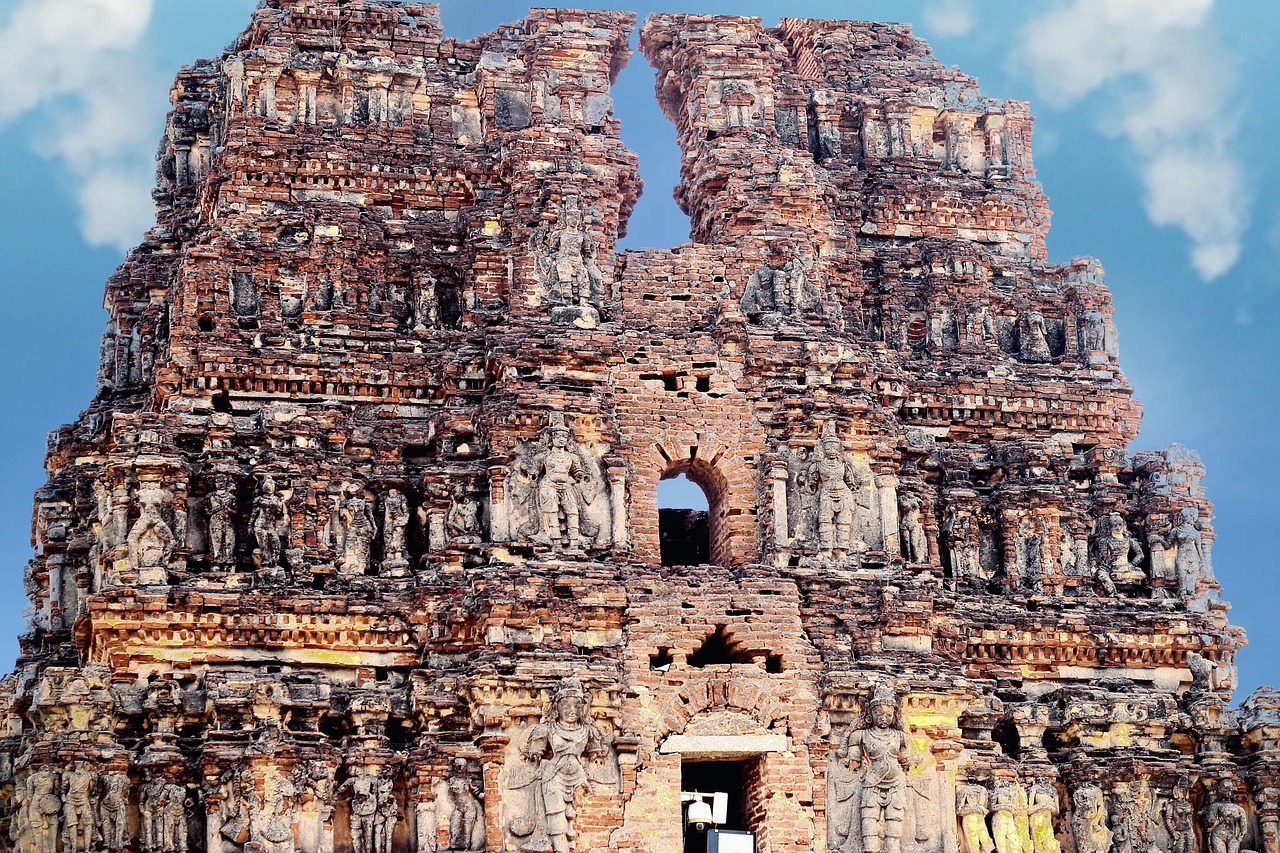
Much of what survives at Hampi — the soaring Virupaksha temple, the elephant stables, the great stone chariot of the Vittala temple, the terraced platforms where the king watched festivals — was raised or expanded during Krishnadevaraya’s reign. He built a whole new suburb and named it for his mother. This is the rare case where a “golden age” left receipts you can still walk through.
The king who wrote poetry
Here is where Krishnadevaraya slips the usual mould of the conqueror.
He was, himself, a poet — and a genuinely good one. He wrote the Amuktamalyada, a Telugu epic retelling the story of the Tamil saint-poet Andal and her foster-father Vishnuchitta. It is not a vanity project remembered only because a king wrote it; it holds a real place in Telugu literature. Tucked inside it is a passage of frank political advice on how a ruler should govern — statecraft, from a man who was actually running a state, in verse.
And he pulled talent toward his court like gravity. Tradition remembers the Ashtadiggajas — the “eight elephants” who held up the eight directions — a group of star Telugu poets who worked under his patronage, the most famous being Allasani Peddana, honored as something like the poet laureate of the age. Krishnadevaraya moved easily across languages, at home in Telugu, Kannada, Sanskrit, and Tamil, and he spread his patronage across all of them. His reign is remembered as a high-water mark for Telugu writing specifically — a literary golden age riding on top of a military and commercial one.
He backed the temples with the same open hand, endowing shrines across the south — Tirupati above all, which he is said to have visited again and again — and honoring the different sects of Hinduism rather than picking one. A hard man on the battlefield; a generous and cultured one at home.
And then it was over — fast
Krishnadevaraya died on 17 October 1529, still in his forties. The empire he left was arguably the strongest state in India.
It did not stay that way, and the speed of the fall is the gut-punch of the whole story.
Power passed, after some turmoil, into the hands of a formidable strongman named Aliya Rama Raya, who ran the empire as regent. Rama Raya played the Deccan sultanates the way a card sharp plays a table — allying with one against another, backing this sultan today and that one tomorrow, keeping his rivals divided and Vijayanagara on top. For years it worked brilliantly. It also, eventually, taught his enemies a lesson: the only way to beat Vijayanagara was to stop fighting each other.
Talikota, and the six months that ended a city
In January 1565, they did. Four of the Deccan sultanates — Bijapur, Ahmadnagar, Golconda, and Bidar — set aside their quarrels, sealed the alliance with marriages, and marched together against Rama Raya. The armies met on 23 January 1565 at a spot remembered as Talikota (or Rakkasa-Tangadi).
It was a catastrophe for Vijayanagara. Partway through the battle, key Muslim commanders in Rama Raya’s own army switched sides — and it’s worth pausing on that, because it cuts against the easy story. The aged Rama Raya was captured and beheaded on the field. His forces collapsed.
Do not read this as a tidy war of Hindu against Muslim. Historians who have looked hard at it — Richard Eaton foremost among them — reject that framing outright. Vijayanagara’s own army included Muslim officers; Rama Raya had spent years allied with Muslim sultans against other Muslim sultans; the sultanates ganged up not over faith but over a rival who had grown too strong and too clever at keeping them apart. This was a struggle for territory and dominance in the Deccan, with alliances that crossed every religious line on the map. The religion of the players was not the reason for the fight.
What came after Talikota is what makes it unforgettable. The victorious armies moved into the undefended capital and, over roughly six months, systematically looted and burned it. The greatest city in southern India — Paes’s Rome-sized wonder — was stripped, gutted, and abandoned. It was never truly rebuilt.
The ruins remember
Walk into Hampi today and you walk through the aftermath. The temples still stand in their strange lunar landscape of granite boulders; the market colonnades run empty; the stone chariot sits where it always sat. UNESCO inscribed the “Group of Monuments at Hampi” as a World Heritage Site in 1986 — some sixteen hundred surviving structures spread across the old imperial ground, one of the most evocative ruins anywhere in the world.
The distance between the two Hampis is the whole point. The city of temples and diamonds and half a million souls, and the silent field of stone — separated by barely a lifetime, and by one battle that Krishnadevaraya did not live to fight.
He got the golden age. He was spared the ending. And that may be the most poignant thing about him: the warrior-poet who took an empire to its dazzling peak and died before the fall, leaving behind a poem, a shattered capital, and a set of ruins grand enough that, five centuries on, we still stand in them and try, like Domingos Paes, to find words big enough.
Sources & further reading
Researched and written with the help of AI tools and edited for accuracy. Provided for general information and discussion only — not professional advice. See our editorial standards and disclaimer. Spotted an error? Tell us.
Enjoyed this? Get the next one.
One good read at a time, straight to your inbox. No spam, unsubscribe anytime.