Photo: kiranbobde2607 / Pixabay
He wasn't a prince of a great kingdom. He was the son of a soldier-for-hire, boxed in by two of the mightiest empires of the age. Yet Shivaji Bhonsle invented a way of fighting, a way of governing, and an idea of self-rule so durable that it broke the Mughal century and echoed, three hundred years later, in India's freedom struggle. This is why his story is extraordinary.
In the middle of the seventeenth century, the Deccan plateau of India was a bad place to be ambitious. To the north loomed the Mughal Empire, the richest and most powerful state on Earth. To the south sprawled the Sultanate of Bijapur. Between them, a patchwork of Maratha chieftains survived by hiring their swords out to whichever empire was paying — soldiers of fortune with no country of their own.
Out of exactly that world came a man who decided the Marathas should stop serving empires and start being one. He began with a single hill fort. By the time he died, he had founded a state that would, within two generations, become the dominant power in India and the last great Indian rival to the British. His name was Shivaji Bhonsle, and the way he did it changed what was thought possible.
A mother, a mentor, and a boy among forts
Shivaji was born in 1630, by the most widely accepted reckoning, in the hill fort of Shivneri. His father, Shahaji, was a capable Maratha general who spent his career in the service of the Deccan sultanates — the very system of hired loyalty his son would come to reject.
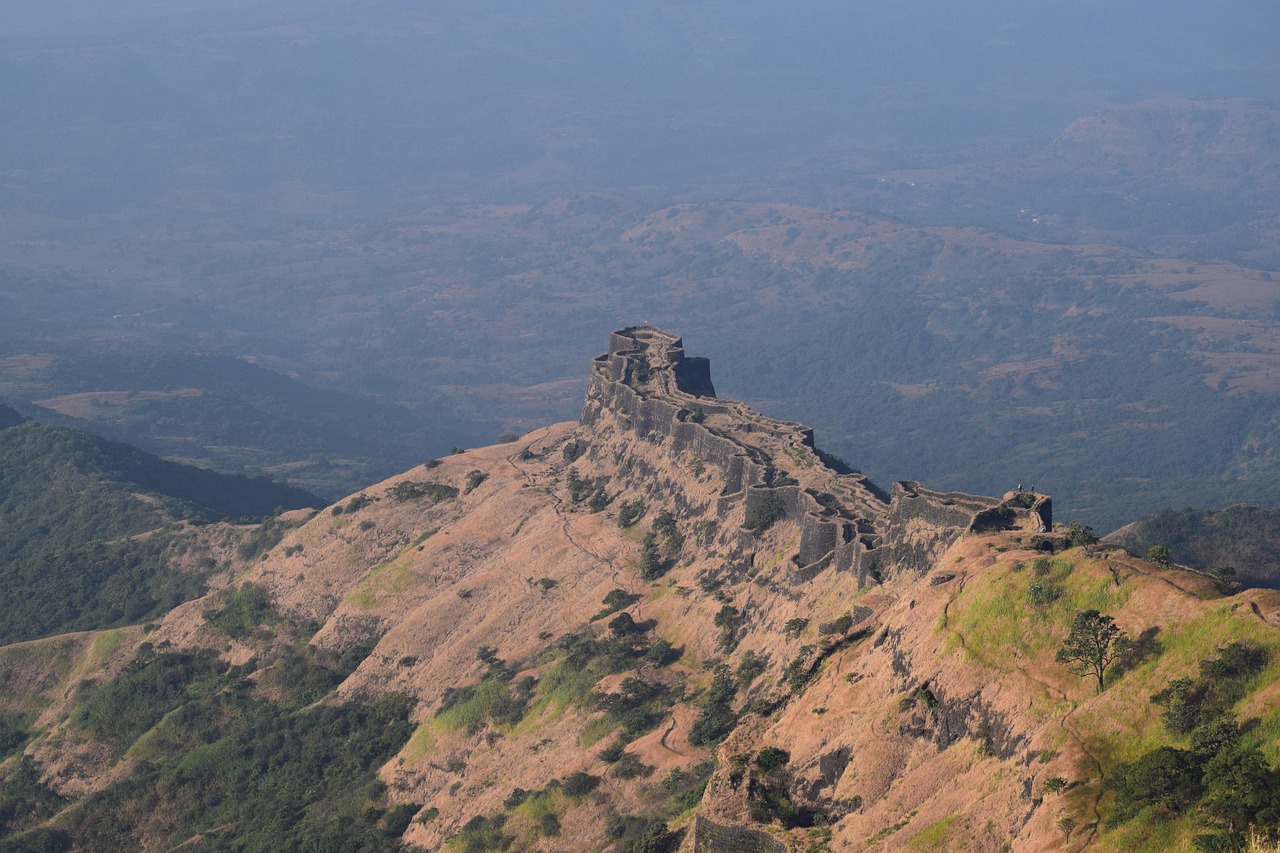
The decisive influence was his mother, Jijabai, who raised him on the epics and on a sense that a Maratha need not be anyone’s instrument. Growing up in the rugged country around Pune, the young Shivaji did something audacious: as a teenager, he simply began taking forts. Torna, then others — strongholds perched in the folds of the Western Ghats, the mountain wall that runs down India’s western spine. Each fort was a foothold. Together they became something no one had authorised: a territory that answered to Shivaji alone.
The art of beating a bigger army
Shivaji’s genius was that he never pretended to fight fair, because fighting fair meant losing. His enemies had more men, more money, more cavalry, more guns. What he had was the mountains, and a completely different theory of war.
His method — later students would call it guerrilla warfare, and Marathi tradition calls it ganimi kava — turned his weaknesses into weapons. Mobility over mass. Surprise over set-piece battle. Hit the enemy’s supply lines, his tax collectors, his soft rear; vanish into terrain the enemy’s heavy armies couldn’t follow; let his forts, studded through impassable hills, blunt every attempt to hold the country. A vast imperial army could march into Shivaji’s land and find nothing to fight and everything to fear.
Two episodes made his reputation, and both read like theatre.
Pratapgad and the tiger’s claws
In 1659, Bijapur sent a formidable general named Afzal Khan to crush him, and Afzal Khan proposed a face-to-face meeting to negotiate — a trap, as Shivaji well understood, since he had every reason to expect treachery. He came to the parley at Pratapgad prepared: armour hidden beneath his clothes, and a set of concealed steel “tiger claws,” the bagh nakh, fitted over his fingers.
When Afzal Khan embraced him and, by most accounts, struck first with a dagger, Shivaji’s armour held — and the tiger claws did not. Afzal Khan died, his leaderless army was ambushed and routed in the hills, and a regional warlord became a legend.
The night raid, and the raid on Surat
The Mughals came next. Aurangzeb sent his own commander, Shaista Khan, who occupied Pune and settled in comfortably. In 1663, Shivaji did the unthinkable: he slipped into the general’s own guarded quarters at night with a small band and attacked him in his private apartments. Shaista Khan escaped with his life but lost fingers to a sword stroke in the dark — and the Mughal Empire lost a great deal of face.
The following year, 1664, Shivaji sacked Surat, the wealthiest port of the Mughal Empire, and carried off a fortune that helped fund his growing state. He was no longer a nuisance in the hills. He was a strategic problem for the greatest empire in the world.
The escape from Agra
That problem produced the most famous episode of his life. After a temporary setback — a treaty in 1665 that forced him to give up forts and submit — Shivaji travelled north in 1666 to Aurangzeb’s court at Agra. There the emperor slighted him, placing him among lesser nobles. Shivaji protested openly, and Aurangzeb had him put under house arrest, with execution a real possibility.
What happened next is the stuff of folklore, and it’s true in outline: Shivaji arranged for large baskets of sweets to be sent daily from his confinement as gifts to holy men and nobles. The guards grew used to the baskets. And one day Shivaji and his young son Sambhaji were carried out of captivity hidden inside them — and made the long journey home. The Mughal Empire had held him in its capital, and he had walked out under its nose in a fruit basket.
Building a state, not just an army
Here is where Shivaji rises above the category of brilliant rebel. Plenty of men can win battles. Shivaji built the machinery of a lasting state.
He created a navy — coastal forts and a fighting fleet to contest the western seas against the Siddis, the Portuguese, and the English, which is why he’s sometimes remembered as a father of Indian naval power. He organised his government around the Ashtapradhan, a council of eight ministers with defined portfolios. He reformed revenue collection to be fairer and more systematic. And he deliberately replaced Persian, the language of the imperial court, with Marathi and Sanskrit in administration — a statement that this was an indigenous state, not an imitation of the empires around it.
In 1674, he made it official. At his fortress capital of Raigad, on the 6th of June, he had himself crowned Chhatrapati — sovereign — in an elaborate ceremony. The point of the coronation was not vanity. It was legitimacy: a formal declaration that the Marathas were now a kingdom in their own right, under a concept he called Hindavi Swarajya — self-rule of the people of the land. That word, swarajya, self-rule, would be picked up almost three centuries later by the leaders of India’s freedom movement. It travels remarkably well.
The part of his record most often distorted
Because Shivaji is sometimes flattened, today, into a purely sectarian symbol, it’s worth being precise about the historical record — and the record is clear. Shivaji’s wars were political and territorial, fought against specific empires, not against a religion.
He issued strict standing orders that his soldiers were not to harm mosques, to desecrate the Quran, or to molest women — including in enemy territory. He is recorded showing respect to copies of the Quran and handing them to Muslims in his service. He employed Muslims as soldiers, as generals, and in his administration, and protected Muslim shrines and holy men. His own chief justice recorded the principle that everyone in his domain was free to follow his own faith. A man who fought Aurangzeb for a lifetime did so as a rival sovereign, not as a persecutor of Aurangzeb’s co-religionists — and that distinction is exactly what tends to get erased when his memory is put to political use.
Why the story is extraordinary
Shivaji died in 1680, only about fifty years old. He did not live to see what he had started. But the Maratha state he built did not die with him; it grew, and in the eighteenth century, as the Mughal Empire crumbled, the Marathas became the paramount power across much of India — the force the British would eventually have to defeat to complete their conquest.
Strip away the folklore and what remains is genuinely rare: a man born with no throne, hemmed in by two of the mightiest empires of his age, who invented a way of fighting that let the small beat the large, a way of governing that outlasted him by a century, and an idea — self-rule — durable enough to be borrowed by a nation three hundred years later.
He started with one hill fort and a few hundred men. That’s the part worth sitting with. Everything else — the empire, the navy, the legend — grew from a young man who looked at the two greatest powers on Earth and decided his people would kneel to neither.
Sources & further reading
Researched and written with the help of AI tools and edited for accuracy. Provided for general information and discussion only — not professional advice. See our editorial standards and disclaimer. Spotted an error? Tell us.
Enjoyed this? Get the next one.
One good read at a time, straight to your inbox. No spam, unsubscribe anytime.