Photo: jyotipandalai / Pixabay
A thousand years before anyone talked about Indian sea power, a south Indian king named Rajaraja was sending fleets to Sri Lanka and the Maldives, taxing the trade lanes between Arabia and China, and raising a granite temple so vast and so precisely engineered that it has outlived every empire that came after it. The story of medieval India is usually told about the north. Here is the one about the south — and the sea.
Stand at the base of the great temple in Thanjavur and look straight up, and you run into a problem that has bothered people for a thousand years.
At the very top of the tower — some 216 feet up, higher than a twenty-storey building — sits an enormous block of granite, the crowning stone of the whole structure. It weighs roughly 80 tonnes. The temple was finished around 1010 CE. There were no cranes, no diesel, no steel cable.
So how did they get an 80-tonne stone up there?
The old answer, the one the guides still tell you, is a ramp four miles long, built on a gentle slope so that elephants and men could drag the stone slowly to the sky and then lower it into place. Whether the ramp is history or legend, the stone is real, and it is still up there. Which tells you the essential thing about the man who ordered the building of it. He did not think small.
The king the north forgot to teach you about
His name was Rajaraja Chola I, and he ruled a south Indian empire from roughly 985 to 1014 CE. If your sense of medieval Indian history is a procession of northern dynasties — Delhi, the Mughals, the Gangetic plain — that is not your fault. It is just an incomplete map. Because while all of that was still centuries from taking its familiar shape, a Tamil king on the Kaveri river delta was running one of the most sophisticated states in the medieval world, and pointing its power out to sea.
He was born Arulmozhi Varman, a younger son of the Chola line, around 947 CE. The Cholas were an ancient Tamil dynasty who had spent a long stretch in the shadows, subordinate to their neighbours. When Arulmozhi took the throne on the death of his uncle Uttama around 985 and adopted the regnal name Rajaraja — “king of kings” — the name was a statement of intent. He spent the next three decades making it literal.
First, the neighbours
Rajaraja’s early campaigns read like a man methodically removing every rival within reach.
Around 988 his forces struck the coast of Kerala and, according to his own inscriptions, destroyed a fleet at a place called Kandalur Salai. He liked the victory so much he stamped it into his royal title: he became, in the formulaic praise-poetry carved on his temples, “the one who destroyed the ships at Kandalur Salai.” He broke the Pandya kingdom to the south and took its capital, Madurai. He pushed north to raid the powerful Western Chalukyas across the Tungabhadra river. By the end, he had swept up most of southern India under one authority.
But the land campaigns are the ordinary part. The extraordinary part is that Rajaraja did not stop at the coastline. For most rulers, the sea was the edge of the map. For him, it was the next frontier.
The Bay of Bengal becomes a Chola pond
Look at where the Chola heartland sat, and the strategy writes itself. The Coromandel coast faces east, straight into the Bay of Bengal — the sea lane that carried goods between Arabia and East Africa on one side and China and Southeast Asia on the other. Whoever controlled the choke points on that route controlled a river of wealth.
Rajaraja set out to control them.
He invaded the island of Lanka — today’s Sri Lanka — and sacked its ancient capital, Anuradhapura. He annexed the northern part of the island outright and folded it into his empire as a province with a new name, Mummudi Chola Mandalam, complete with a permanent Chola administrative seat. That gave him command of the Palk Strait, the narrow water between India and Sri Lanka, and with it a hand on the traffic passing between the western and eastern halves of the Indian Ocean.
Then, near the end of his reign, his ships went further still — out into the open ocean to the southwest, to the ring-shaped coral islands of the Maldives, and the Lakshadweep group closer to home. Britannica records both as Chola conquests. These were not border raids you could ride to on a horse. They were blue-water expeditions: a fleet crossing hundreds of miles of empty sea to seize islands that mattered because they sat astride the trade winds and produced the cowrie shells that served as currency across the medieval Indian Ocean.
This is the detail worth pausing on. A thousand years ago, a south Indian state was conducting deliberate naval power projection across the Bay of Bengal and out into the wider ocean. Not trading. Not coastal raiding. Conquering, garrisoning, and taxing — by sea.
The son who finished the thought
Rajaraja laid the keel, and his son sailed it out.
When Rajaraja died in 1014, the throne passed to Rajendra Chola I, and Rajendra took the maritime idea to its audacious conclusion. Around 1025 he launched a naval expedition clear across the Bay of Bengal against Srivijaya, the great maritime power of the Malay world in what is now Indonesia and Malaysia — one of the very few times a premodern Indian state carried war across the sea to Southeast Asia. Rajendra gets the headline. But the navy, the shipyards, the strategy, and the appetite were Rajaraja’s inheritance to give.
For a couple of generations, the Chola fleet made the Bay of Bengal something close to an internal lake — and opened a channel of trade, culture, and Tamil influence into Southeast Asia whose traces you can still find in the temples of the region.
A state that ran on paper — carved in stone
Conquest is loud, so it gets remembered. The quieter thing Rajaraja built was arguably more remarkable: a state that actually worked.
He was a genuine administrator, not just a warlord. He commissioned a land survey and reorganised his empire into revenue units — called valanadus — assessed on the productivity of the land, so the state knew what it had and what it could tax. He clipped the wings of the hereditary aristocracy, replacing inherited local power with officials who answered to him. This was a centralised, surveyed, audited empire, at a time when much of the world still ran on personal loyalty and rough guesswork.
And underneath the imperial machinery sat something that startles modern readers: functioning local self-government.
Chola villages governed a great deal of their own affairs through assemblies. Non-Brahmin villages had a body called the ur; the Brahmin settlements had one called the sabha; trading towns had a nagaram. These assemblies ran through specialised committees — for irrigation tanks, gardens, temples, justice, gold — and the details are not guesswork, because the villagers carved their own bylaws into stone. The famous inscriptions at Uttaramerur, from slightly before Rajaraja’s time, spell out an actual electoral system: wards, eligibility rules for candidates, disqualifications for corruption, even a lottery-style draw of names from a pot to fill the committees.
Rajaraja didn’t invent this system — he inherited it. But he ran an empire that let it keep working, which is its own kind of achievement. A medieval state that both surveyed its land from the top and let its villages elect their own committees from the bottom is not the picture most of us carry of the year 1000.
The temple was a machine
Which brings us back to Thanjavur, and the granite mountain.
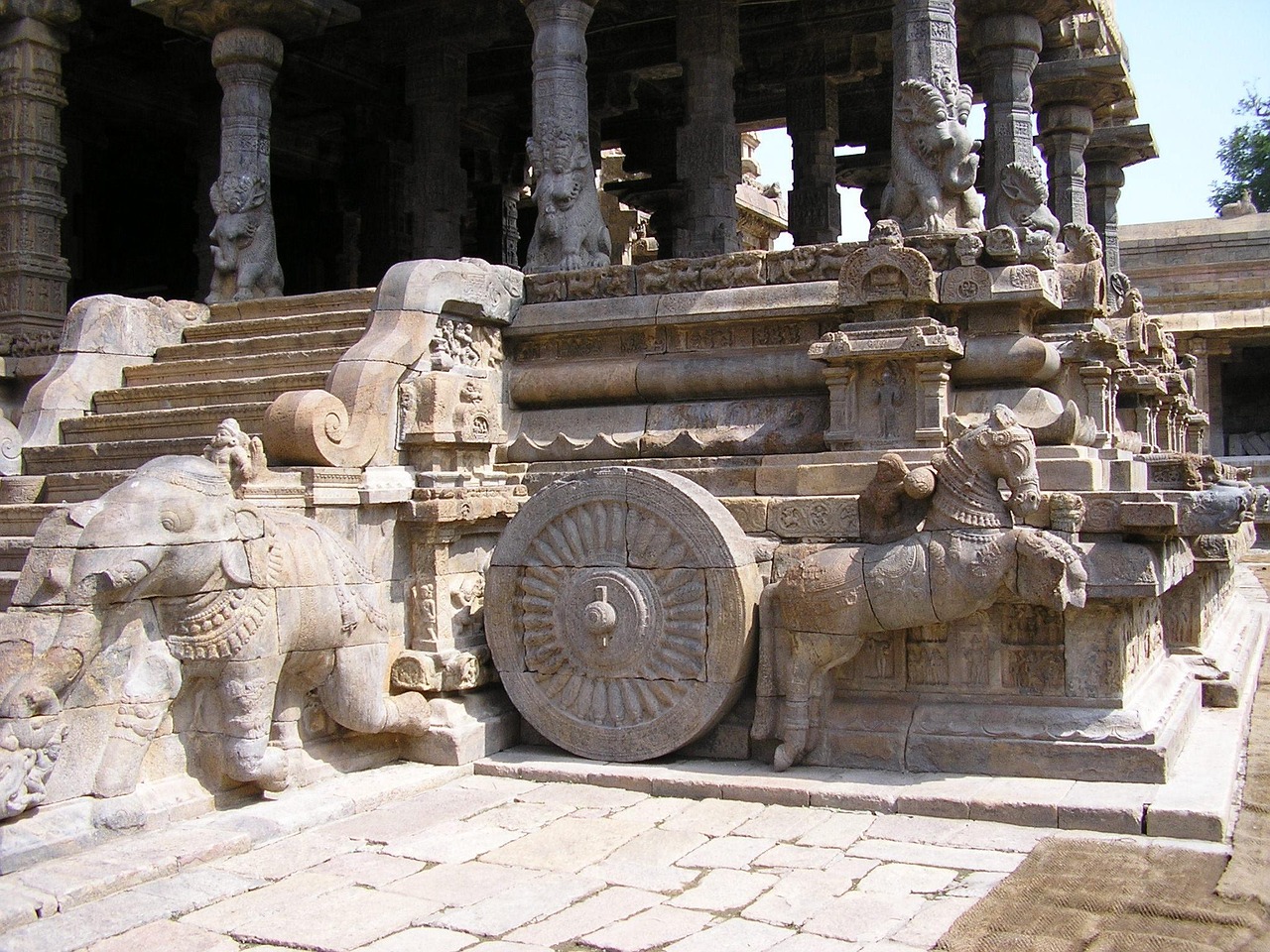
The temple Rajaraja raised there — he named it Rajarajeswaram, after himself; today it is the Brihadeeswarar, or Brihadishvara, temple — was the largest in India when it was built, dedicated to the god Shiva and finished around 1010 CE. Its pyramidal tower, the vimana, rises in thirteen diminishing tiers to a height Britannica puts at more than 200 feet, and which is commonly measured at about 216 feet, or 66 metres. It is built of thousands of tonnes of granite — a stone so hard it is brutal to carve — and the nearest source of that granite was at least 30 miles up the Kaveri. It was assembled, astonishingly, without mortar: interlocking blocks, held by their own precision and weight. UNESCO inscribed it as a World Heritage Site in 1987, and it anchors the group it calls the “Great Living Chola Temples.”
But here is the part the engineering marvel can hide. The temple was not just a monument. It was an economic engine.
Rajaraja endowed it in perpetuity and then had the accounts carved into the walls, and those inscriptions are one of the great documentary treasures of medieval India. They list, in exhausting and precise detail, the land grants that funded it, the names of donors, the measurements of fields, and the wages and duties of everyone on the payroll. And the payroll was enormous. The temple recorded some 400 dancers — for whom the king built two whole streets of housing near the temple — alongside priests, musicians, accountants, garland-makers, cooks, gardeners, watchmen. At its height it is thought to have supported on the order of a thousand people.
Around it churned a whole economy: merchants supplying flowers and milk and ghee, endowments of land and gold and livestock feeding a permanent institution. The temple gathered the empire’s surplus, redistributed it as employment and ritual, and recorded every transaction in stone. It was, in a real sense, the central bank, welfare office, concert hall, and cathedral of the Chola state, all at one address.
Why he still matters
Rajaraja died in 1014, and the empire he built kept expanding under his son before, like all empires, it eventually receded. But the tower he raised never fell. It is still there, granite and vertical, a thousand years and change later — outlasting every dynasty, colonial power, and border that has washed over south India since.
Sit with the whole picture and it rearranges something. A king on the Kaveri delta, a full millennium ago, ran a surveyed and centralised state that still left room for villages to elect their own councils, funded a temple whose account-books doubled as a census, and sent fleets across open ocean to plant his flag on coral islands and command the trade of half the Indian Ocean.
We are used to thinking of blue-water empires as a much later, much more northern, much more European idea. Rajaraja Chola is the quiet correction to that story. The Bay of Bengal had a superpower long before the Atlantic did — and it left the receipt carved eighty tonnes deep, at the top of a tower that refuses to come down.
Sources & further reading
Researched and written with the help of AI tools and edited for accuracy. Provided for general information and discussion only — not professional advice. See our editorial standards and disclaimer. Spotted an error? Tell us.
Enjoyed this? Get the next one.
One good read at a time, straight to your inbox. No spam, unsubscribe anytime.