He lost an eye to smallpox before he could walk, never learned to read past the alphabet, and took a great walled city at eighteen. Then Ranjit Singh did the harder thing: he welded a dozen quarrelling Sikh warbands into a single kingdom, built a European-trained army, and ran a state where a Muslim held the foreign ministry and a Hindu the treasury. For forty years he was the one Indian power the British could not push past. Then he died — and within ten years all of it was gone.
Smallpox got to him before almost anything else did. As an infant, in the flat farm country north of Lahore, the disease scarred his face and took the sight of his left eye. He would grow up short, pockmarked, one-eyed, and — by the standards of any royal court — barely literate, never taught to read or write beyond the Gurmukhi alphabet.
That is the man who would end up called the Lion of Punjab. His name was Ranjit Singh, and by the time he died he ruled the last great independent kingdom in the north of India — the one power the rising British could not shove aside.
Here’s the part that should stop you: he did it starting as a teenager. And here’s the part that should haunt you: within ten years of his death, every bit of it was gone.
A boy inherits a warband
Ranjit Singh was born on 13 November 1780, in what is now Pakistani Punjab. His inheritance was not a throne. It was a misl — one of roughly a dozen Sikh military confederacies that had carved up the Punjab between them after the collapse of Mughal and Afghan authority in the region.
Think of the misls as warbands with tax rolls: mounted, proud, endlessly feuding, each holding a patch of the plains and none strong enough to swallow the rest. When his father died in 1792, Ranjit Singh inherited leadership of the Sukerchakia misl. He was about twelve.
He did not stay a boy chieftain for long.
Lahore at eighteen
In July 1799, still a teenager, Ranjit Singh took Lahore — the historic capital of the Punjab, a walled Mughal city that meant something. It was the move that turned a misl leader into a contender.
Two years later, in 1801, he made it official. He had himself proclaimed Maharaja of the Punjab. Not a misldar. Not first among equals. A king.
The audacity of that is easy to skate past. The whole logic of the misls was that no Sikh chief ruled over the others; sovereignty belonged to the Khalsa, the community, collectively. Ranjit Singh looked at that arrangement and decided the Punjab needed one hand on it, and that the hand would be his. Over the following years he absorbed rival misls one after another — by war, by marriage, by pressure, by patronage — until the patchwork of warbands had become a single kingdom answering to Lahore.
The army he bought from Napoleon’s leftovers
A kingdom needs an army, and Ranjit Singh built one unlike anything else in India.
The traditional strength of the Sikhs was fast, ferocious cavalry. Ranjit Singh kept that and grafted something new onto it: disciplined, drilled infantry and artillery on the European model. To do it, he went shopping in the wreckage of the Napoleonic Wars.
After Waterloo, Europe was full of unemployed professional soldiers. From 1822 onward, Ranjit Singh hired them — the Punjabis called them firangis, foreigners. Jean-François Allard, a French cavalry officer who had served in Napoleon’s armies, came to modernise his horse. Jean-Baptiste Ventura, from an Italian Jewish family, drilled his infantry in French style. Others followed: Claude Auguste Court, a graduate of France’s Saint-Cyr academy; Paolo Avitabile, an Italian gunner.
Together they built the Fauj-i-Khas, his elite European-trained corps, and reshaped the wider Sikh Khalsa Army into a standing force numbering in the tens of thousands — one museum estimate puts the Khalsa at around 85,000 troops. This was not a feudal levy. It was a modern army, drilled on the “latest Napoleonic model,” officered by veterans from across Europe, and it made the Punjab a genuine military state.
It also produced a fact the British found deeply annoying: for the whole of his reign, the East India Company — which was steadily eating the rest of the subcontinent — could not eat the Punjab.
The line at the Sutlej
By the early 1800s the British had a habit of expanding right up to whatever they couldn’t yet take, and then taking it. Ranjit Singh gave them a line they had to respect.
In 1809 came the Treaty of Amritsar, signed with the East India Company that April. Its core term was a border: the Sutlej River. Ranjit Singh would not push his power south of the Sutlej; the British would not meddle north of it. The river became the frontier between British India and the Sikh Empire.
On paper it looks like a limit on his ambitions, and it was — the Sikh chiefs south of the Sutlej slipped into the British orbit. But look at what it bought him. With his southern border fixed and his rear secure, Ranjit Singh was free to turn the other way and expand for the next thirty years — into Multan, Kashmir, Peshawar — without the British at his back.
At its height his empire ran from the Khyber Pass in the northwest to the Sutlej in the east, from Kashmir in the north down to the edge of the Thar Desert. And he did something no Indian ruler had managed in centuries: he pushed the traditional invaders of India — the Afghans, coming as they always had through the mountain passes — back the other way, taking Peshawar and carrying Sikh power to the mouth of the Khyber. That reversal is why they called him the Lion.
A Sikh king, a Muslim minister, a Hindu treasurer
Now the part of his record that matters most, and that gets flattened most.
Ranjit Singh was a devout Sikh who ruled a population that was mostly Muslim, with a large Hindu minority and Sikhs a minority in their own empire. He could have run it as a sectarian state. He did the opposite.
His court was staffed by competence, not creed. His foreign minister, the trusted diplomat who handled his dealings with the British, was Fakir Azizuddin — a Muslim. His prime minister, Dhian Singh, was a Dogra Hindu. His finance minister, Dina Nath, was a Hindu Brahmin. His army carried Sikhs, Muslims, and Hindus in its ranks, and his European Christian generals besides.
There is a story about Azizuddin that captures the tone of the whole regime. Ranjit Singh once asked his Muslim minister whether he leaned toward Hinduism or Islam. Azizuddin answered that he was like a man in a boat in the middle of a river, looking at both banks equally.
Under Ranjit Singh’s rule there were, by the record, no forced conversions. He is remembered for a light hand on religion in an age not known for it — a ruler who put a Muslim over his foreign policy and a Hindu over his money while sitting on a Sikh throne.
A word of caution, because history is not a morality tale: this was a nineteenth-century warlord-king, not a modern secular democracy, and it’s easy to over-polish him. But the even-handedness across faiths is not legend. It is documented, in his ministries and his army, and it made his state unusually plural for its time and place.
Gold on the temple, a diamond on his arm
Two objects tell you how far he had come.
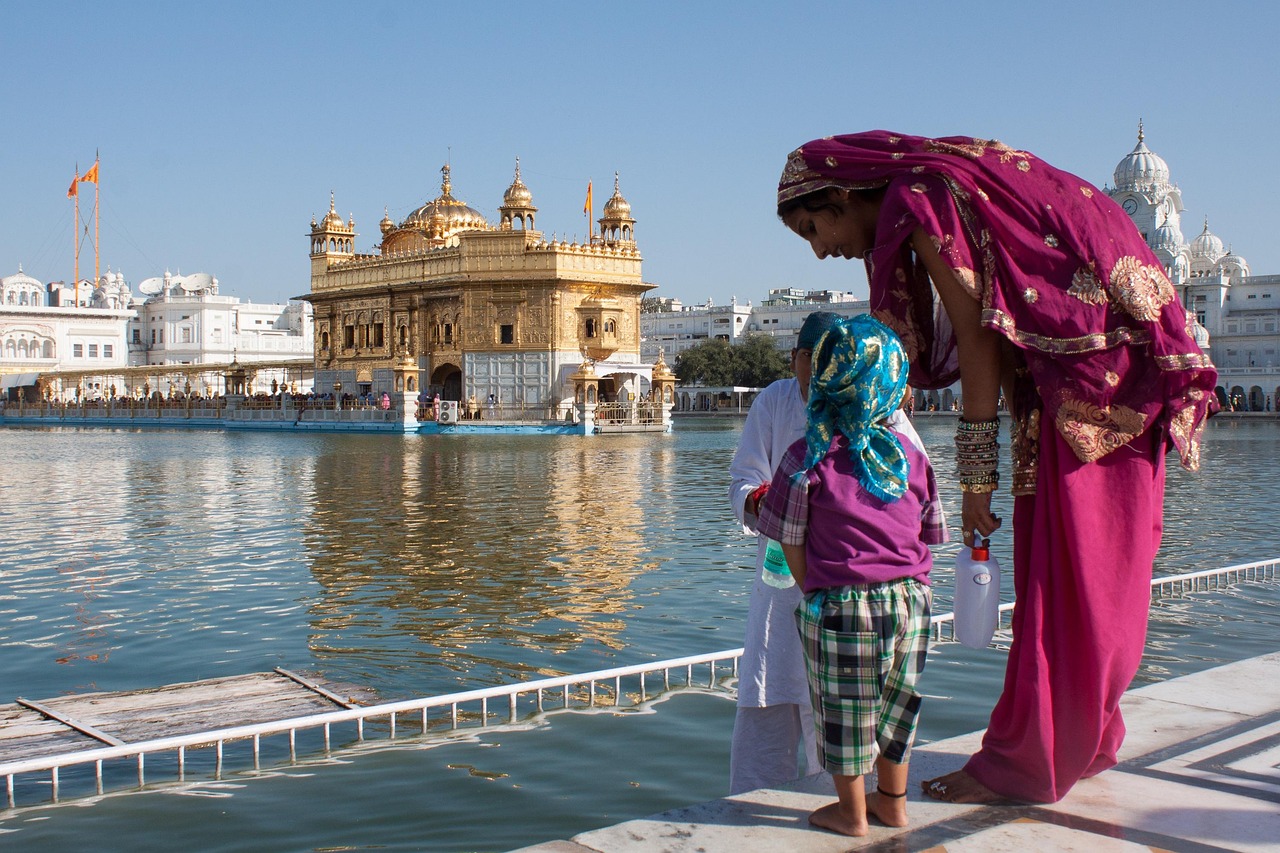
The first is the Harmandir Sahib at Amritsar — the holiest shrine in Sikhism. During Ranjit Singh’s reign its upper stories were overlaid with gilded copper panels and a gold-foil-covered dome, its lower walls faced in white marble inlaid with precious stones. That gold is why the world now calls it the Golden Temple. He gave the faith’s central place its shimmer.
The second is the Koh-i-Noor. In 1813 the deposed Afghan king Shah Shuja, a fugitive in Lahore, handed over the legendary diamond to Ranjit Singh. The Maharaja wore it on his arm — a stone that had passed through Mughals and Persians and Afghans, now on the bicep of a one-eyed Sikh who had started with a single warband. It was as loud a statement of arrival as an object can make.
The ten-year unravelling
Ranjit Singh died on 27 June 1839, in Lahore, after nearly four decades in power. And here the story turns cruel, because everything that held the empire together turned out to be him.
He had built a state around a single extraordinary will, and had not built a way to survive its absence. What followed his death was a decade of palace murder and coup — heirs and ministers killed in quick, bloody succession — while the one institution that kept growing, the mighty Khalsa Army, grew restless and political with no master strong enough to command it.
The British, patient across the Sutlej for thirty years, watched the vacuum and moved. The First Anglo-Sikh War (1845–46) and then the Second (1848–49) broke the Sikh state. In 1849 the Governor-General, Lord Dalhousie, annexed the Punjab outright. The last maharaja, Ranjit Singh’s young son Duleep Singh, was eleven; he was deposed, separated from his mother, and eventually shipped off to England on a pension.
And the diamond? Ranjit Singh had wanted the Koh-i-Noor given to a temple. Instead, the treaty that dissolved his empire in 1849 handed it to the East India Company, which handed it to Queen Victoria. It was set among the British Crown Jewels, where it sits today.
Why it stays with you
Add up the distance he travelled. A one-eyed, pockmarked, barely-literate boy inherits a warband, takes a great city as a teenager, welds a dozen feuding chiefdoms into a kingdom, hires Napoleon’s veterans to build a modern army, runs a genuinely cross-faith state in an age of holy wars, and for forty years holds the line against the empire that swallowed everything else in India.
Then he dies, and it takes the machine ten years to fall apart — not because his enemies were stronger, but because he had never made his kingdom bigger than himself.
That’s the thing worth sitting with. Ranjit Singh proved an Indian power could match Europe on the battlefield and still be plural at home. He also proved how fragile a state is when it rests on one remarkable man. The gold he laid on the temple at Amritsar is still there, catching the light. The diamond he wore on his arm is in London. Both are, in their way, honest monuments to the Lion of Punjab — one to what he built, the other to how quickly it was taken.
Sources & further reading
Researched and written with the help of AI tools and edited for accuracy. Provided for general information and discussion only — not professional advice. See our editorial standards and disclaimer. Spotted an error? Tell us.
Enjoyed this? Get the next one.
One good read at a time, straight to your inbox. No spam, unsubscribe anytime.