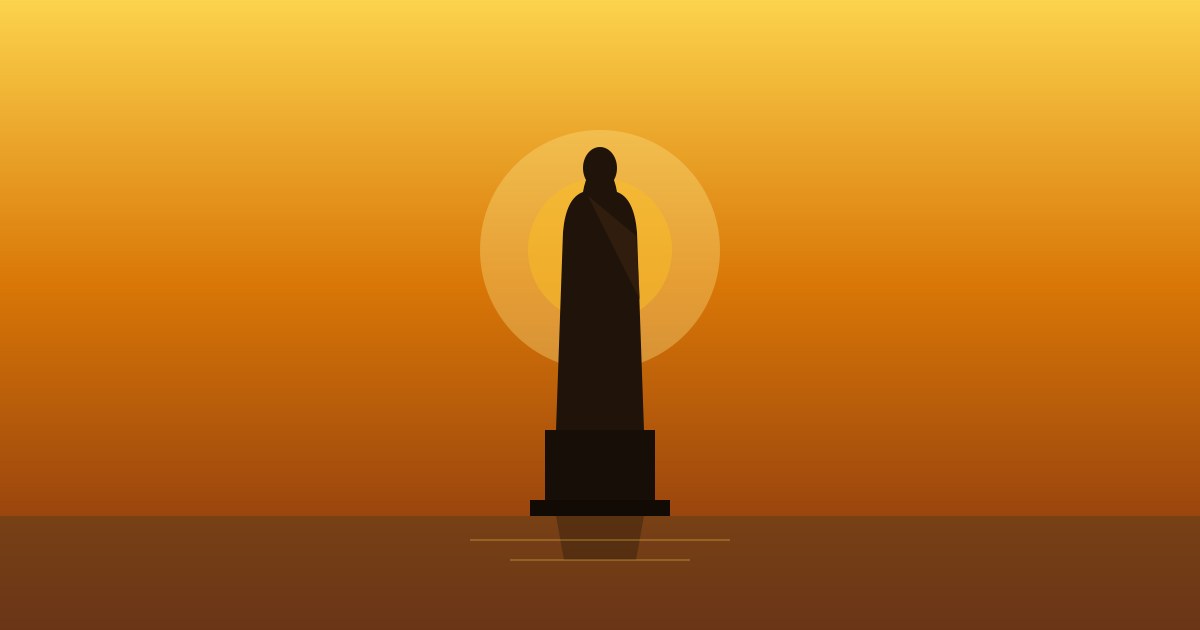
Illustration by tuput
It rises 182 metres from an island in the Narmada — twice the Statue of Liberty, and taller than any statue humanity has ever built. It depicts Sardar Vallabhbhai Patel, the 'Iron Man' who talked 560-odd kingdoms into becoming one country. This is the story of the man, the numbers, and the staggering feat of engineering that put him on the skyline.
Picture a man standing on a small island in a river in western India, gazing out over a dam. Now make him 182 metres tall — taller than the Great Pyramid of Giza, taller than any statue humanity has ever built, tall enough that his rolled-up coat and folded shawl are visible from kilometres away.
That man is the tallest statue on Earth. And here is the strange part: outside India, almost nobody knows who he is.
He is Sardar Vallabhbhai Patel, and the reason a country decided to make him the biggest human figure ever cast is one of the quieter, stranger stories in the making of a modern nation.
The man who talked 500 kingdoms into a country
When the British left India in August 1947, they did not hand over one tidy country. They handed over a jigsaw.
Alongside British-ruled provinces sat more than 560 “princely states” — kingdoms large and small, each with its own ruler, technically freed by the Indian Independence Act of 1947 to go their own way. Some were the size of a European nation. Some were a few villages. Any one of them could, in theory, have opted out — leaving independent India as a moth-eaten map, riddled with holes.
The man handed the job of stitching them in was Patel, independent India’s first Deputy Prime Minister and Home Minister, per Encyclopædia Britannica. A lawyer from Gujarat who had risen through Gandhi’s freedom movement, he was already known as “Sardar” — chief — and would become known as the “Iron Man of India.”
His instrument was, fittingly, a document called the Instrument of Accession: a legal agreement by which each ruler signed his state into the Indian Union. Patel, working with his deputy V. P. Menon, mixed persuasion, appeals to patriotism, generous pensions for the princes, and — where charm failed — the unmistakable implication of force. State by state, signature by signature, the holes in the map closed.
He got almost all of them. The handful that resisted — Junagadh, Hyderabad, the still-unfinished business of Kashmir — became the exceptions that proved how total his success had been. In a matter of months, a subcontinent that could have splintered into dozens of pieces became, more or less, a single country.
That is the achievement the statue is really about. Not a battle. A negotiation — hundreds of them — that gave India its shape.
Why put it on a river island in Gujarat
The location is not random. The statue stands on Sadhu Bet, a rocky island in the Narmada river in Gujarat, facing the Sardar Sarovar Dam — a dam named for Patel himself, a few kilometres downstream.
It was Prime Minister Narendra Modi, then chief minister of Gujarat, who championed the project. It was inaugurated on 31 October 2018, Patel’s birth anniversary, and formally named the Statue of Unity — the word doing the heavy lifting, since unity is precisely what Patel is remembered for.
The height was chosen with a wink. 182 metres matches the 182 seats in the Gujarat state assembly. It is a number picked, in part, to mean something.
How tall is 182 metres, really
Numbers this big stop meaning anything, so let’s anchor them.
The Statue of Liberty, measured from the ground to the tip of her torch — pedestal included — is about 93 metres. Patel is roughly twice that. And if you compare figure to figure, ignoring pedestals, Lady Liberty’s copper body is only about 46 metres from heel to crown. Patel’s figure is very nearly four times taller.
Christ the Redeemer, arms spread over Rio de Janeiro, is about 30 metres of statue on an 8-metre pedestal. You could stack six of him and still not reach Patel’s head.
And the previous record holder? That was the Spring Temple Buddha in Henan, China, at roughly 128 metres. The Statue of Unity clears it by more than 50 metres — not nudging past the old record but vaulting over it.
For scale at the site: the 182-metre figure itself stands on a 58-metre base, so the whole structure rises about 240 metres from the ground. A viewing gallery near the statue’s chest, around 153 metres up, can hold some 200 visitors, who look out from inside Patel’s heart at the dam and the Satpura and Vindhya hills beyond.
The problem with building a 182-metre man
Here is where the engineers earn their keep. A statue is not a skyscraper. A tower is designed to be a tower — regular, symmetrical, built for wind. A human figure is a nightmare of the opposite: lopsided, slender in the wrong places, with a heavy head perched far above a comparatively narrow body. It is, structurally, a very tall thing that badly wants to sway and topple.
The contract went to India’s engineering giant Larsen & Toubro (L&T), which won the bid at roughly ₹2,989 crore — about US$400 million — for the design, construction and upkeep. The sculptor was India’s celebrated Ram V. Sutar, who shaped Patel’s likeness; L&T, with structural engineers at Arup, had to make that likeness stand up for centuries.
Their solution hides inside the figure. Two reinforced-concrete cores rise from the foundations up through Patel’s legs to around his chest — roughly 127 metres of concrete spine, which also houses the high-speed lifts that carry visitors to the gallery. Wrapped around that spine is a complex three-dimensional steel frame, and hung on the steel is the skin: the bronze.
The material tally is enormous. Roughly 210,000 cubic metres of cement and concrete. Around 6,500 tonnes of structural steel and 18,500 tonnes of reinforcing steel. And about 1,850 tonnes of bronze cladding — the weathering outer surface — formed from 565 large “macro” panels and some 6,000 smaller “micro” panels, each shaped, numbered, and fitted like the world’s heaviest jigsaw.
Then there is the wind. Gujarat sits in a seismically active zone, and a figure this slender catches gusts like a sail. So the statue was engineered to stand in winds of up to 180 km/h and to ride out significant earthquakes, and — the elegant part — it carries a pair of tuned mass dampers of around 200 tonnes apiece. These are essentially giant counterweights, hung high inside the frame, that swing against the statue’s motion and cancel out the sway. The same trick that keeps supertall towers from making their occupants seasick keeps Patel from trembling in a storm.
L&T says its teams raised the statue itself in a startlingly short window — the company puts the core construction at around 33 months — with the whole project spanning roughly four years from the 2014 groundbreaking to the 2018 unveiling.
The awkward truth about the skin
One detail became a genuine controversy: the bronze.
When the builders surveyed India’s foundries, they found that none of the country’s major bronze workshops could cast panels at this scale. So the bronze cladding was cast at a foundry in China — the TQ Art foundry in Jiangxi — and shipped to Gujarat to be assembled on site.
For a monument sold as a symbol of Indian self-reliance, “made partly in China” was an irresistible line of attack, and critics used it. L&T’s response was that the Chinese work amounted to only about 9 percent of the project’s value — the panels alone — while the statue was engineered, erected and finished in India. Both things are true at once, which is usually how these arguments go.
Awe, and the argument against it
The Statue of Unity is genuinely awe-inspiring. It draws millions of visitors, it holds a world record, and as a feat of engineering it is hard not to admire.
It has also drawn serious criticism, and honesty requires naming it. The roughly US$400 million price tag struck many as extravagant in a country where deep poverty persists — a colossal outlay, opponents argued, on a statue rather than on schools or hospitals. And the project sat in the territory of the Narmada dam, long a flashpoint over the displacement of local and tribal communities. At the 2018 inauguration, residents of dozens of tribal villages staged a boycott, saying they had been pushed off land and inadequately compensated. Supporters counter that the monument has brought tourism, jobs and infrastructure to a long-neglected corner of Gujarat.
Both the wonder and the objection are part of the record. A statue this size does not get to be only one thing.
The figure on the island
Strip away the politics and the record-books, and what remains is a peculiar and rather moving fact.
Most of the world builds its tallest monuments to gods, or to abstractions — a Buddha, a liberty, a redeemer. India built its tallest to an administrator. To the man who did the unglamorous, essential work of persuading 560 kings to give up their crowns so that a country could exist at all.
He never held the top job. He was the deputy, the fixer, the Iron Man in the second chair. He died in 1950, barely three years into the republic he had helped hold together, and for decades he was remembered mostly in textbooks.
Now he stands 182 metres over the Narmada, looking down at a dam that carries his name, the largest human figure the species has ever made. It is an odd kind of immortality — enormous, contested, expensive, and pointed squarely at the thing he actually did.
Not conquest. Not a throne. Just the quiet, stubborn insistence that all of it should be one country.
Sources & further reading
Researched and written with the help of AI tools and edited for accuracy. Provided for general information and discussion only — not professional advice. See our editorial standards and disclaimer. Spotted an error? Tell us.
Enjoyed this? Get the next one.
One good read at a time, straight to your inbox. No spam, unsubscribe anytime.