Photo: WikiImages / Pixabay
India got to Mars on its first try, landed near the Moon's south pole when no one ever had, and did it all on budgets that would embarrass a studio accountant. The story of frugal engineering.
In November 2013, India launched a spacecraft to Mars. The whole mission — the probe, the rocket, the ground stations, the years of engineering — cost about ₹450 crore. Roughly $74 million.
The Hollywood film Gravity, released a month earlier, cost more than that to make.
Ten months later, on 24 September 2014, the little orbiter slid into orbit around Mars. It worked on the first try. No nation had ever managed that before.
That single fact — interplanetary success for less than the price of a space movie — is the neatest summary of what the Indian Space Research Organisation does. But it’s not a fluke, or a one-off headline. It’s a method. ISRO has spent two decades doing world-class space science for a fraction of what everyone else pays, and calling it, half-jokingly, “frugal engineering.”
Here’s how the shoestring became a superpower.
The movie-budget Mars mission
The mission was called Mangalyaan — Sanskrit for “Mars craft” — officially the Mars Orbiter Mission. It launched on 5 November 2013 aboard a PSLV rocket and reached Martian orbit the following September.
The cost comparison that went around the world was real. NASA’s MAVEN orbiter arrived at Mars two days before Mangalyaan, carrying more instruments and doing more science — but it cost about $671 million, nearly ten times as much. Mangalyaan came in under the $100-million-ish budget of Gravity, a detail India’s own prime minister enjoyed pointing out.
How? Partly by being small — the spacecraft’s dry mass was under 500 kg — and by reusing proven hardware from India’s earlier Moon probe. Partly because salaries and infrastructure in India cost a fraction of what they do in the West. And partly by accepting a modest six-month design life rather than gold-plating everything for a decade.
The irony: Mangalyaan kept working for about eight years, far outliving its brief. ISRO finally declared it lost in October 2022, after the ageing orbiter ran out of fuel and power to survive a long eclipse.
The first-try club of one
It’s worth being precise about the “first” here, because it gets garbled a lot.
India was the first nation to reach Mars orbit on its very first attempt. The United States, the Soviet Union, and later Europe all reached Mars — but every one of them tallied failures before, or on the way to, success. Mars is a graveyard of dead probes; more missions there have failed than succeeded. India threaded the needle once and made it.
That made ISRO only the fourth space agency ever to orbit Mars, after the Soviet program, NASA, and the European Space Agency. First Asian nation to get there, too. Not bad for a mission that cost less than a summer blockbuster.
Landing where no one had landed
If Mangalyaan made the world notice, Chandrayaan-3 made it stop and stare.
On 23 August 2023, India’s Vikram lander touched down gently on the Moon at roughly 69 degrees south — deep in the lunar south polar region. With that, India became the fourth country ever to soft-land on the Moon, after the Soviet Union, the United States, and China.
But the bigger “first” was geographic. No spacecraft in history had ever soft-landed that close to the lunar south pole. Everyone before had come down nearer the equator, where landing is easier and sunlight is reliable. The south pole is the hard, interesting neighbourhood: rugged, shadowed, and — crucially — home to craters that may hold water ice, the raw material for future drinking water, breathable oxygen, and rocket fuel.
A small solar-powered rover named Pragyan (“wisdom”) rolled down a ramp and spent one lunar day — about two Earth weeks — trundling across the regolith and sampling the soil before the long polar night shut it down. The whole mission cost around ₹600 crore, well under $100 million.
The world’s spacefaring nations are now racing toward that same south pole. India got there first, and got there cheap.
The failure that came first
None of this was smooth, and ISRO doesn’t pretend it was.
Chandrayaan-3 exists because Chandrayaan-2 crashed. In September 2019, its near-identical predecessor tried the same landing. In the final minutes of descent, roughly two kilometres above the surface, the lander’s trajectory drifted, its velocity climbed too high, and it slammed into the Moon. Mission control watched the data flatline in a room full of cameras. The ISRO chairman was famously filmed being embraced, in tears, by the prime minister the next morning.
What ISRO did next is the part worth remembering. Engineers spent four years dissecting the failure, widening the landing zone, toughening the software, adding fuel margin, and rebuilding the legs to survive a harder touchdown. Chandrayaan-3 was, in effect, the same idea with every weakness from 2019 sanded down. The frugal method isn’t magic; it’s iteration, and a willingness to fail in public and fix it.
(The Chandrayaan-2 orbiter, it should be said, is still circling the Moon and working fine. Only the lander was lost.)
The workhorse nobody talks about
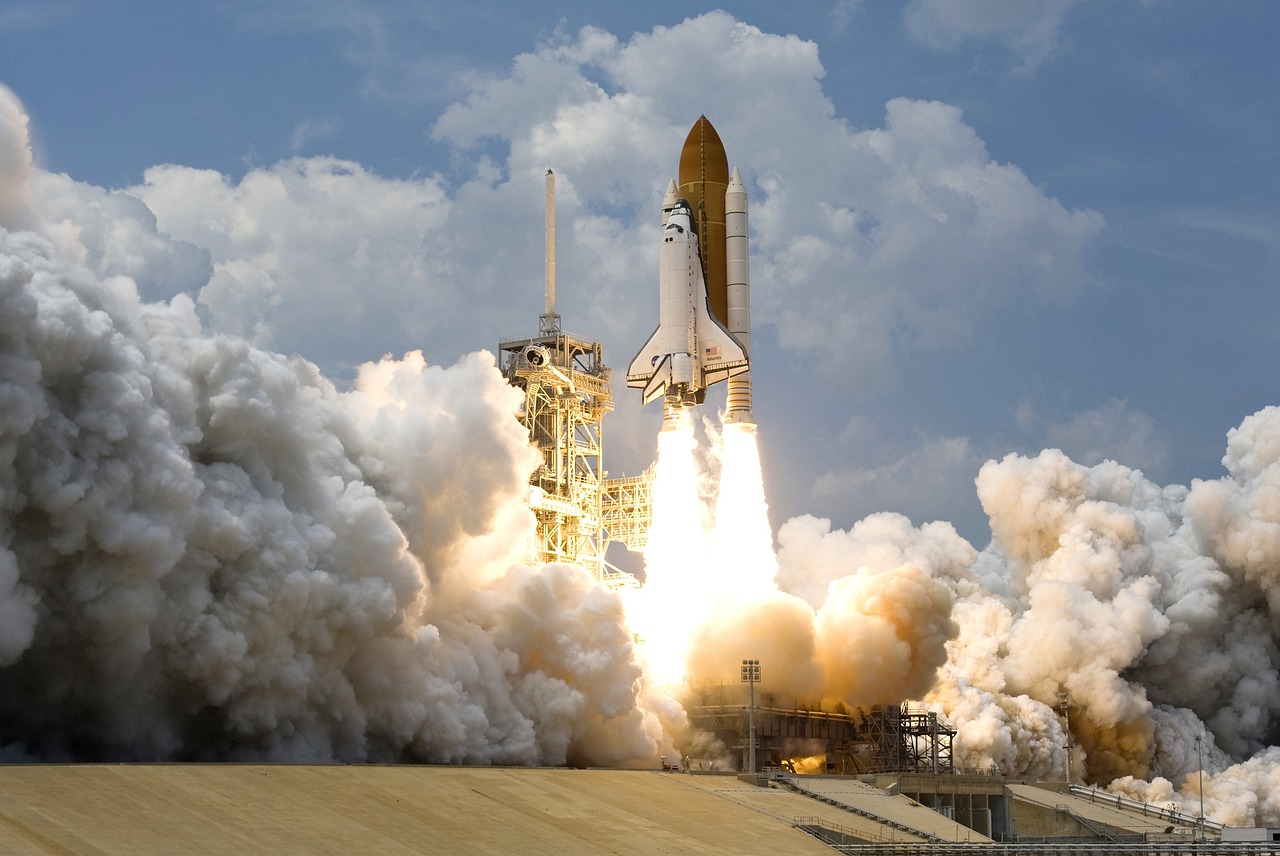
Behind the marquee missions sits an unglamorous rocket that does most of the actual work: the Polar Satellite Launch Vehicle, or PSLV.
The PSLV is the reliable pickup truck of the launch world — not the biggest or flashiest, but trusted enough that other countries pay India to fly their satellites on it. It carried both Mangalyaan and India’s first Moon probe out of Earth’s gravity.
On 14 February 2017, a single PSLV did something no rocket had done before: it deployed 104 satellites in one flight. The primary payload was an Indian Earth-observation satellite; the other 103 were mostly tiny foreign nanosatellites, including 96 from the United States. The previous single-launch record — 37 — belonged to a Russian rocket. India nearly tripled it.
The record has since been beaten (SpaceX packed 143 satellites onto one Falcon 9 in 2021), but the 2017 flight announced something: India wasn’t just a customer of the space age. It was a supplier.
Looking straight at the Sun
The frugal streak didn’t stop at the Moon and Mars.
In September 2023, weeks after the Chandrayaan-3 landing, India launched Aditya-L1, its first mission dedicated to studying the Sun. The tricky part isn’t the launch — it’s the parking spot. Aditya was sent about 1.5 million kilometres from Earth to a gravitational sweet spot called Lagrange Point 1, where a spacecraft can hover with a permanent, unobstructed view of the Sun.
It reached its final halo orbit around L1 on 6 January 2024. From there it watches solar storms and the Sun’s outer atmosphere — the kind of space weather that can fry satellites and knock out power grids back home. Only a handful of agencies operate a solar observatory that far out. India now does too.
Putting an Indian back in space
For all its robotic firsts, India had — until recently — sent only one of its own citizens to space: Rakesh Sharma, who flew aboard a Soviet craft in 1984.
That forty-one-year gap closed in June 2025, when Group Captain Shubhanshu Shukla launched to the International Space Station as pilot of the private Axiom-4 mission. He became the first Indian ever aboard the ISS, and only the second Indian in space. He spent about two weeks in orbit running roughly 60 experiments — a dress rehearsal, of sorts, for India’s own crewed ambitions.
Those ambitions live in a programme called Gaganyaan (“sky craft”), which aims to launch Indian astronauts on an Indian rocket from Indian soil. Here honesty matters more than hype: the timeline has slipped repeatedly. As of mid-2026, ISRO’s chairman indicated the first uncrewed test flight may not fly until the third quarter of 2027, pushing the first crewed launch to 2028 or later (per statements reported in July 2026 — treat any specific date as provisional; ISRO’s own targets keep moving). Four Indian Air Force pilots have been named as the astronaut candidates, and a humanoid robot, Vyommitra, is slated to ride the first test flight.
Human spaceflight is the one arena where frugality meets its limit: you cannot cut corners on keeping people alive, and India isn’t trying to. Slow and careful is the right speed.
The business of doing it cheap
There’s a commercial engine underneath all this now. ISRO’s launches are marketed through a state-owned company, NSIL (NewSpace India Limited), which sells rides to foreign customers. When the British-Indian operator OneWeb needed to loft its internet satellites, it turned to India: two LVM3 rockets carried 72 OneWeb craft in 2022 and 2023, reportedly earning India well over ₹1,000 crore in foreign exchange.
Low cost isn’t just national pride. It’s a product.
What “frugal” actually means
It’s tempting to read all this as a story about being poor and clever — making do, cutting corners, getting lucky. That misreads it.
Look at the numbers. India’s entire space budget runs around $1.6 billion a year. NASA’s is roughly $25 billion — about sixteen times larger. And yet the smaller agency reached Mars on its first attempt, landed where no one had touched the Moon before, and parked an observatory a million-plus kilometres away to watch the Sun.
Frugal engineering isn’t the absence of ambition. It’s a discipline: build small, reuse what works, test relentlessly, accept a failure or two as tuition, and refuse to spend a rupee on anything the mission doesn’t strictly need. It’s the opposite of the old space-race logic, where cost was proof of seriousness.
The lesson India keeps quietly teaching is that the two can be separated — that you can do the hardest things humans attempt, and not go broke doing them. A generation of new spacefaring nations is watching, notebook in hand.
The movie Gravity won seven Oscars. The spacecraft that cost less than it is drifting, silent now, somewhere in orbit around Mars — having gotten there first, and having gotten there cheap.
Sources & further reading
Researched and written with the help of AI tools and edited for accuracy. Provided for general information and discussion only — not professional advice. See our editorial standards and disclaimer. Spotted an error? Tell us.
Enjoyed this? Get the next one.
One good read at a time, straight to your inbox. No spam, unsubscribe anytime.