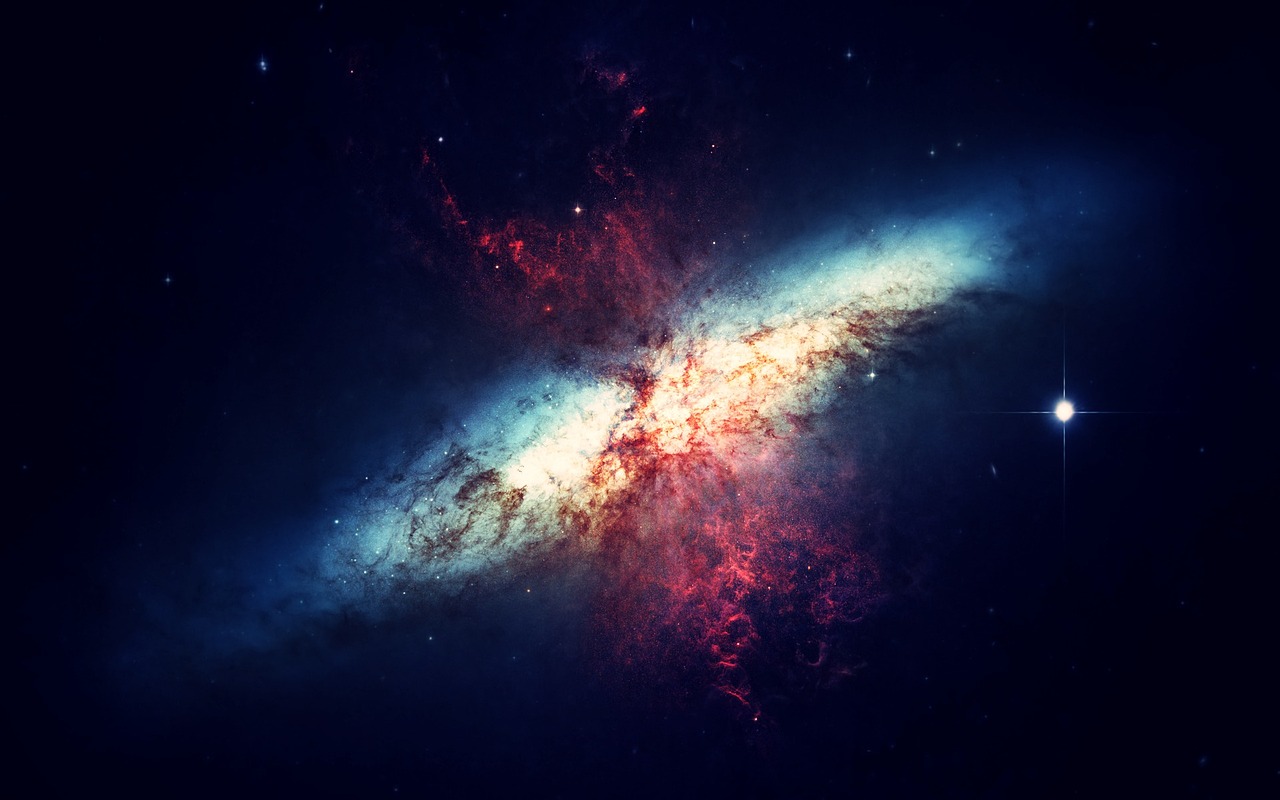
Photo: WikiImages / Pixabay
When two black holes smash together, they shake the fabric of spacetime itself. A decade ago we detected that shudder for the very first time. Today, catching them has become almost routine — and each one is a message from the darkest objects in the universe.
Imagine the universe has a surface, like the skin of a drum, and that this surface is not empty space but space itself — the very fabric that everything is stitched into. Now imagine two black holes, each many times heavier than the Sun, spiralling into each other at nearly the speed of light and merging in an instant.
That collision doesn’t just make light or sound. It makes the drumhead of the cosmos ring. Ripples in spacetime spread outward across the universe at the speed of light. And, incredibly, we’ve built machines that can feel them arrive.
Einstein’s most outrageous prediction
A century ago, Albert Einstein’s theory of gravity predicted these ripples — gravitational waves — as a consequence of his equations. Even he doubted we’d ever detect them. The effect is almost unimaginably tiny: by the time a wave from a distant black-hole merger reaches Earth, it stretches and squeezes space by less than the width of an atomic nucleus.
Measuring that is like gauging the distance to the nearest star to within the thickness of a human hair. For decades it was considered essentially impossible.
The day we first felt the universe shake
Then, in 2015, an instrument called LIGO — a pair of detectors with laser beams running down tunnels kilometres long — caught it. A faint, rising “chirp” swept through the machines: the final fraction of a second of two black holes, more than a billion light-years away, becoming one.
It was the first time humanity had ever directly detected a gravitational wave. The signal matched Einstein’s prediction almost perfectly, confirming a piece of physics a hundred years after it was written down. The achievement won the 2017 Nobel Prize in Physics, and it opened an entirely new way of studying the cosmos.
A new sense for the universe
Here’s why it matters so much. For all of history, astronomy has been about light — visible light, radio waves, X-rays, all forms of the same thing. But black holes are dark. Colliding in empty space, they emit no light at all. To ordinary telescopes, these are among the most violent events in the universe, and they happen completely unseen.
Gravitational waves changed that. They gave us, in effect, a new sense — a way to “hear” events that emit no light. Every detection is a message from an object or a cataclysm that would otherwise be invisible to us forever.
From a miracle to a catalog
What began as a once-in-a-century miracle has become something close to routine. As the detectors have grown more sensitive — and been joined by partner observatories around the world — the trickle of detections has become a flood. Where scientists once celebrated a single event, they now maintain a growing catalog of hundreds of black-hole and neutron-star collisions, each one a genuine event somewhere out in the dark.
That catalog is quietly rewriting what we know: how common black holes are, how big they get, how they pair up, and what happens in the instant two of them become one. We’ve even caught neutron stars colliding — an event that did produce light, letting telescopes and gravitational-wave detectors witness the same cosmic crash together for the first time.
Listening to the dark
A hundred years ago, gravitational waves were a line of mathematics its own author thought we’d never test. A decade ago, we felt one for the first time. Today, we keep a running list.
There is something quietly staggering in that. We have learned to sit still on a small planet and feel the shudder of black holes colliding across a billion light-years of space — to listen, in a way no generation before us ever could, to the darkest music in the universe.
Sources & further reading
Researched and written with the help of AI tools and edited for accuracy. Provided for general information and discussion only — not professional advice. See our editorial standards and disclaimer. Spotted an error? Tell us.
Enjoyed this? Get the next one.
One good read at a time, straight to your inbox. No spam, unsubscribe anytime.